
A V-shape SUP board is a stand-up paddle board whose underside is shaped like the keel of a boat — a distinct V-profile hull that runs from the nose through the midsection and into the tail. Unlike the flat-bottom boards that dominate the all-round market, a V-shape board is engineered to cut through water rather than push against it. The result is a board built for speed, straight-line tracking, and confident handling in open water.
If you are researching boards for your own brand, a rental fleet, or a racing program, understanding the V-hull is the difference between buying a marketing claim and buying real hydrodynamic performance. This guide explains what a V-shape SUP board is, how it performs, why it is genuinely harder to manufacture, and — for buyers and brand owners — how to source one through a reliable OEM ODM SUP factory with a low MOQ paddle board program.
What Exactly Is a V-Shape SUP Board?
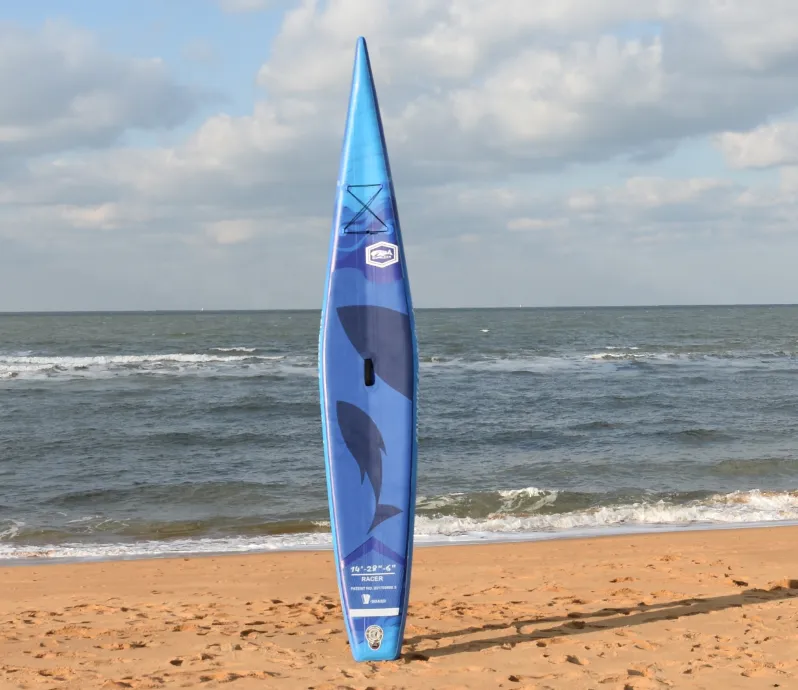
At its core, a V-shape SUP board is defined by the cross-section of its hull. A standard inflatable SUP has a flat or slightly rounded bottom; when you paddle, that flat surface slaps and planes on the water. A V-shape board replaces that flat plane with a sharp central ridge. Water that meets the nose is split evenly to both sides, then released cleanly along the hull lines instead of being trapped underneath.
This single design choice changes three things at once:
- Tracking. The board wants to go straight. In crosswinds and chop, a flat board wanders; a V-hull holds its line with far fewer corrective strokes.
- Speed. Less water resistance means more of your paddle energy becomes forward motion. At touring pace the difference is obvious; at race pace it is decisive.
- Stability in rough water. A flat board sits on the surface and gets tossed by every wavelet. A V-hull settles into the water, giving a smoother, more predictable secondary stability.
Because of these traits, V-shape boards are not beginner products. They reward technique and experience — which is exactly why premium brands and competitive paddlers value them.
How the V-Hull Actually Works
Hydrodynamics explains the advantage. When a flat bottom moves forward, it creates a broad pressure wave underneath that drags the board down (form drag). A V-hull converts that problem into a feature: the angled surfaces redirect water outward and downward, reducing the trapped cushion and letting the board “knife” forward.
Two design details matter most:
- V-depth and sharpness. A deeper, sharper V tracks better but sacrifices a little initial stability. A shallower V is a compromise for mixed-use boards.
- Consistency of the line. The V must be symmetrical and constant from nose to tail. Any wobble in the hull line shows up as wandering at speed — which is why manufacturing precision is non-negotiable.
V-Shape vs Flat-Bottom SUP Board
| Feature | V-Shape SUP Board | Flat-Bottom SUP Board |
|---|---|---|
| Top speed | High | Medium |
| Tracking | Excellent | Average |
| Choppy-water stability | Very good | Average |
| Skill level | Advanced | Beginner-friendly |
| Manufacturing difficulty | Very high | Low |
For a casual paddler on a calm lake, a flat board is perfectly adequate and more forgiving. For anyone crossing open water, training for fitness, or racing, the V-hull is the professional choice.
Why V-Shape Boards Are Harder to Build
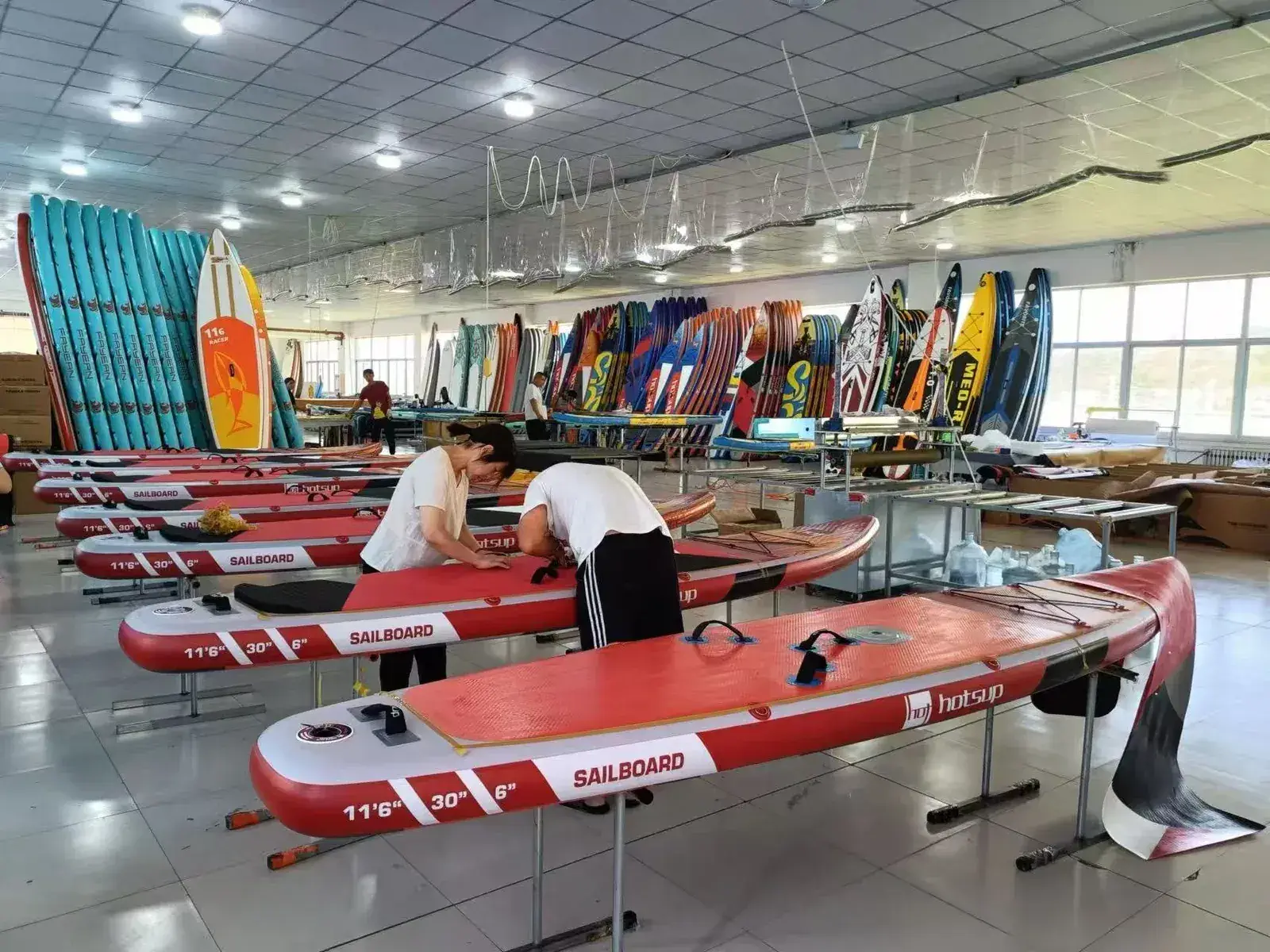
This is the part most buyers overlook, and it is the reason only a limited number of factories produce true V-shape inflatable SUPs consistently.
- Mold accuracy. The V angle must be perfectly symmetrical. Even a one-degree deviation shifts the board’s balance and destroys tracking. Mold cost and tolerance control are high.
- Drop-stitch shaping. Standard flat drop-stitch fabric is not enough. A V-hull needs custom-shaped drop-stitch panels and precise bonding along the V-line so the board holds its profile at 15 PSI.
- Quality control. Uneven internal pressure can deform the hull; bonding quality decides durability. Each board must pass shape-consistency and pressure tests.
When you source a wholesale inflatable paddle board or a private label paddle board with a V-hull, ask the factory for pressure-test reports and, if possible, a live video of the molding line. A trading company reselling someone else’s boards will struggle to answer these questions.
Who Should Choose a V-Shape Board?
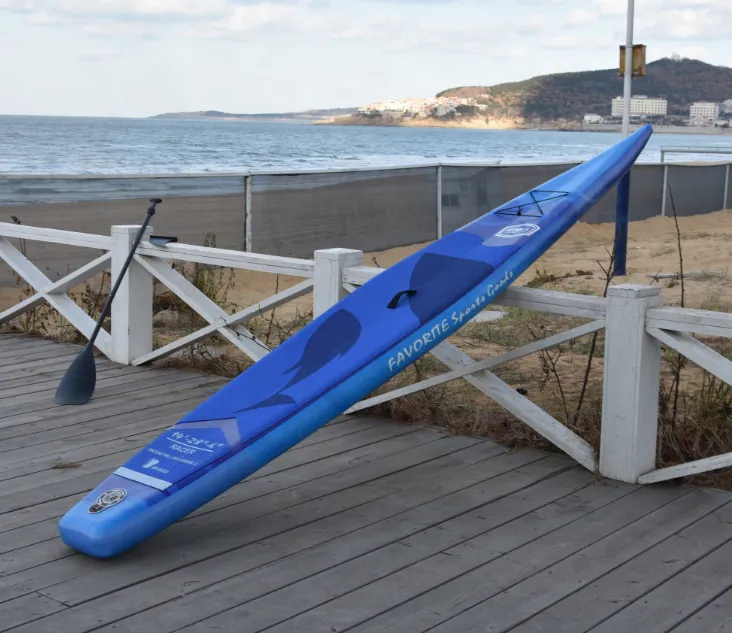
- Racers and fitness paddlers who prioritize speed and glide.
- Touring paddlers crossing lakes, coastlines, and open water.
- Premium brands that want a technical differentiator in a crowded market.
- Rental operators serving experienced guests (note: not for first-timers).
If your audience is mostly beginners, lead with an all-round shape and keep the V-shape as a performance tier.
Building Your Own V-Shape Paddle Board Line
For brand owners, the V-shape is a strong hero product — but only if your manufacturing partner can deliver consistency at low volume. ForwardSUP runs the hull, drop-stitch, and QC in-house, and supports a low MOQ paddle board program starting from a single sample unit. That means you can validate the shape, colorway, and branding before committing to a production run.
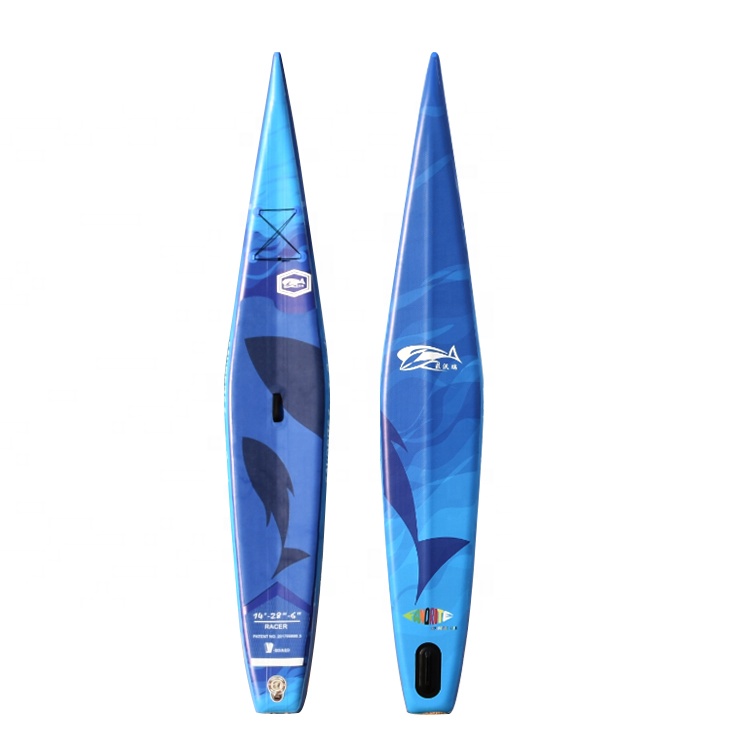
Whether you want a private label paddle board (your artwork on a proven platform) or full OEM development (your spec, our factory), the V-shape is a credible technical statement. See our OEM & ODM capabilities or explore the Half V-Shape and Full V-Shape racing models we build.
Frequently Asked Questions
Is a V-shape SUP board hard to control? Yes — intentionally. It has less initial stability and responds to weight shifts, but rewards skilled paddlers with acceleration and feedback.
Can a beginner use one? Not recommended as a first board. Start flat-bottom, move to V-shape as technique improves.
How do I verify a factory can build it? Request pressure-test data, mold tolerances, and a sample unit. A genuine OEM ODM SUP factory answers in writing.
What MOQ is realistic? With in-house production, sampling from 1 unit is realistic; volume pricing improves from there.
Final Thoughts
A V-shape SUP board is not a mass-market product. It represents advanced hydrodynamic design, high-precision manufacturing, and performance-focused engineering. For serious paddlers and premium brands, a well-made V-hull delivers speed, control, and credibility — on the water and in the market.
Ready to build your own? Request a tailored quote or review our small-batch customization guide.