
Running an inflatable SUP rental business means making one critical decision early: which type of boards will form the backbone of your fleet. The inflatable SUP rental business segment has grown sharply across European waterfronts, lakeshores, and resort destinations — and the board type you choose directly affects your durability, storage costs, transport logistics, and ultimately your return on investment.
This guide breaks down the inflatable versus hard board debate from a rental operator’s perspective, then covers what to demand from a paddle board supplier China partner when sourcing fleet-grade boards for daily customer use.
Why Inflatable SUPs Dominate the Rental Market
Walk into any busy rental station on a European lake or coastal promenade and you will see the same thing: inflatable boards stacked on racks, pumped up in minutes, and handed to customers of all skill levels. The shift is not accidental. Inflatable SUPs solve the three biggest pain points that rental operators face — storage space, transport cost, and damage frequency.
A typical rental station stocking twelve boards can fit an entire inflatable fleet into a single corner of a shipping container or beach hut. Hard epoxy boards of the same count would require dedicated board racks, padded transport vehicles, and significantly more floor space per unit. For businesses operating on premium waterfront real estate, that space difference translates directly into overhead savings.
The water sports product selection guide we published earlier covers the full range of inflatable water sports equipment — but here we focus specifically on what makes a board rental-ready.
Inflatable SUP vs Hard Board: Head-to-Head Comparison
Durability and Damage Resistance
Hard epoxy or fiberglass boards offer a stiffer ride and better glide in flat-water racing conditions — no argument there. But in a rental context, the stiffer the board, the more it punishes impacts. A hard board dropped on a concrete boat ramp develops a ding. An inflatable board dropped from the same height bounces.
Drop-stitch construction used in modern inflatable SUPs creates a rigid platform at 15 PSI or higher — firm enough for touring and fitness classes, yet forgiving enough to survive daily rental abuse. When a beginner paddler runs an inflatable board into a dock piling, the board absorbs the impact. The same impact on a hard board means a repair ticket and downtime.
Storage and Space Requirements
A deflated inflatable SUP rolls into a backpack roughly the size of a sleeping bag. A hard board does not compress. For a rental business operating from a kiosk, a mobile trailer, or a shared beachfront facility, the storage math is straightforward: twelve inflatable boards occupy the space of two hard boards when deflated.
This also means seasonal businesses can pack an entire fleet into storage during off-season without renting warehouse space sized for rigid boards. The cost savings compound year over year.
Transport and Logistics
Inflatable SUPs travel deflated and inflated on-site. A single staff member can load and unload a full fleet from a van without a roof rack. Hard boards require padded roof transport, tie-down systems, and ideally two people per loading session — every single rental day.
For operators running multiple rental locations or pop-up stations, this transport advantage is often the deciding factor. The ability to move boards between sites in a standard vehicle keeps the business model lean and scalable.
The Economics of Inflatable SUP Rental Fleets

The financial case for inflatable boards in a rental business rests on three numbers: acquisition cost, replacement frequency, and revenue per board per day.
Inflatable boards typically retail at a lower price point than composite hard boards of comparable length. When sourced directly from an OEM/ODM SUP factory with rental-grade drop-stitch construction, the per-unit cost drops further — especially under a low MOQ paddle board arrangement where you can start with a small test batch before committing to a full fleet.
Replacement frequency favors inflatables in rental settings. A well-maintained inflatable board in a rental rotation can last three to five seasons. Hard boards in the same rotation often need professional repair within the first season due to impact damage from docks, rocks, and careless handling by first-time paddlers.
Revenue per board per day is where inflatables pull ahead. Faster setup, lighter weight, and the ability to serve beginners confidently means more rentals per day with fewer staff hours spent on board management and customer onboarding.
What Rental Operators Should Demand from Suppliers
Drop-Stitch Density and PSI Ratings
Not all inflatable SUPs are built to withstand daily rental use. The single most important specification to verify with your supplier is drop-stitch density — the number of vertical threads per square inch that bond the top and bottom layers of the board.
Boards built for rental should hold 15 PSI or higher without bulging. Lower-density drop-stitch produces a softer board that flexes under paddler weight, degrades faster, and delivers a poor rental experience that hurts repeat business. For a detailed breakdown of drop-stitch specifications and material quality benchmarks, see our Drop Stitch Material Guide 2026.
Reinforced Rails and Valve Quality
Rental boards live and die by their rail construction and valve reliability. Look for double-layer rail taping at minimum, and insist on high-pressure Halkey-Roberts or similarly rated valves. A faulty valve means a flat board and a dissatisfied customer — every rental operator’s worst review trigger. Quality suppliers will include replacement valves and repair kits as standard in fleet orders.
Building Your Rental Brand with Custom SUP Boards
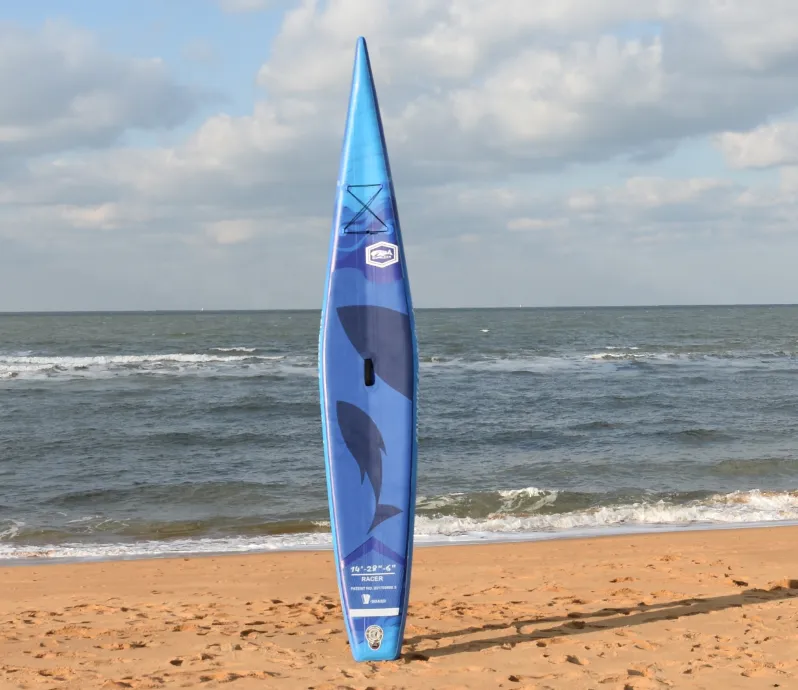
Rental businesses that invest in custom-branded boards stand out on crowded waterfronts. A private label paddle board program lets you specify board color, deck pad design, logo placement, and even hull shape — all produced under your brand identity by a single manufacturing partner.
With a low MOQ paddle board approach, you can launch a branded fleet starting from a single board for sampling, then scale to a full rental set once the prototype meets your quality standard. This is the same model that established rental brands across Europe use — and it is more accessible than many operators realize. Explore the process on our Custom SUP Boards page and learn about OEM partnership options for rental fleet customization.
Full-color printing on the deck, rails, and bottom is standard with most custom SUP board manufacturers. Starting from a single board, you can prototype your branded design and scale to a fleet of any size.
Cross-Selling: Adding Water Bikes to Your Rental Lineup
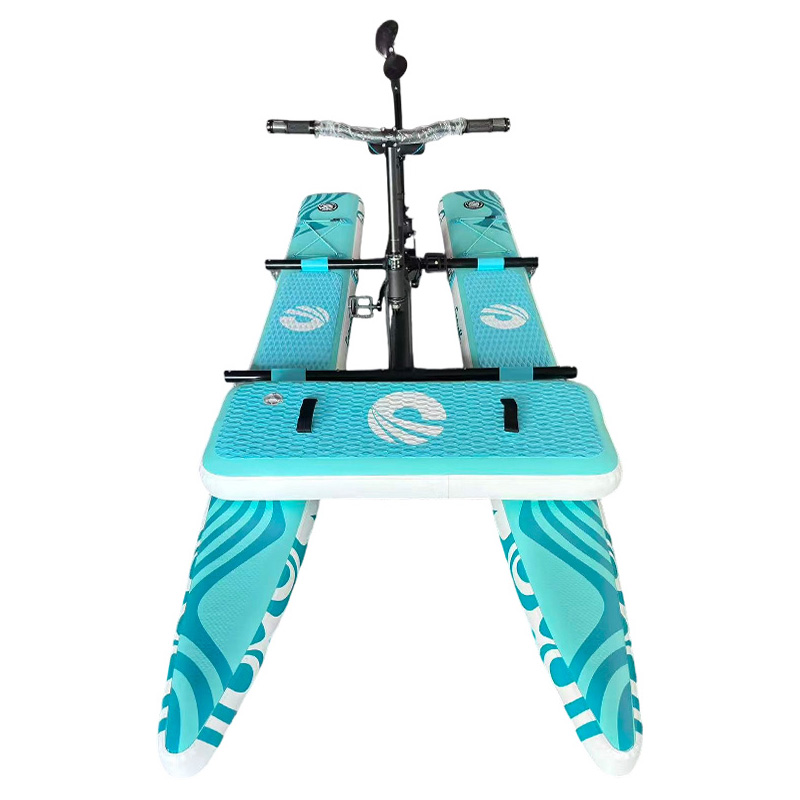
SUP rental operators who add water bikes to their lineup consistently report higher average ticket values. Water bikes attract a different customer segment — fitness enthusiasts, families seeking stability, and tourists looking for something beyond paddling. The logistics are familiar: inflatable construction, same storage footprint, same transport model.
A combined SUP and water bike rental station captures more of the waterfront activity market without doubling your operational complexity. See our water bike product page for specifications, and read the Water Bike Rental Business Guide 2026 for ROI projections and cross-selling strategies.
How to Source Rental-Grade SUP Boards from China
Sourcing fleet boards from a paddle board supplier China partner requires the same due diligence as any B2B manufacturing relationship. The key checkpoints for rental-grade boards:
- Request drop-stitch density specifications in writing — not just PSI claims
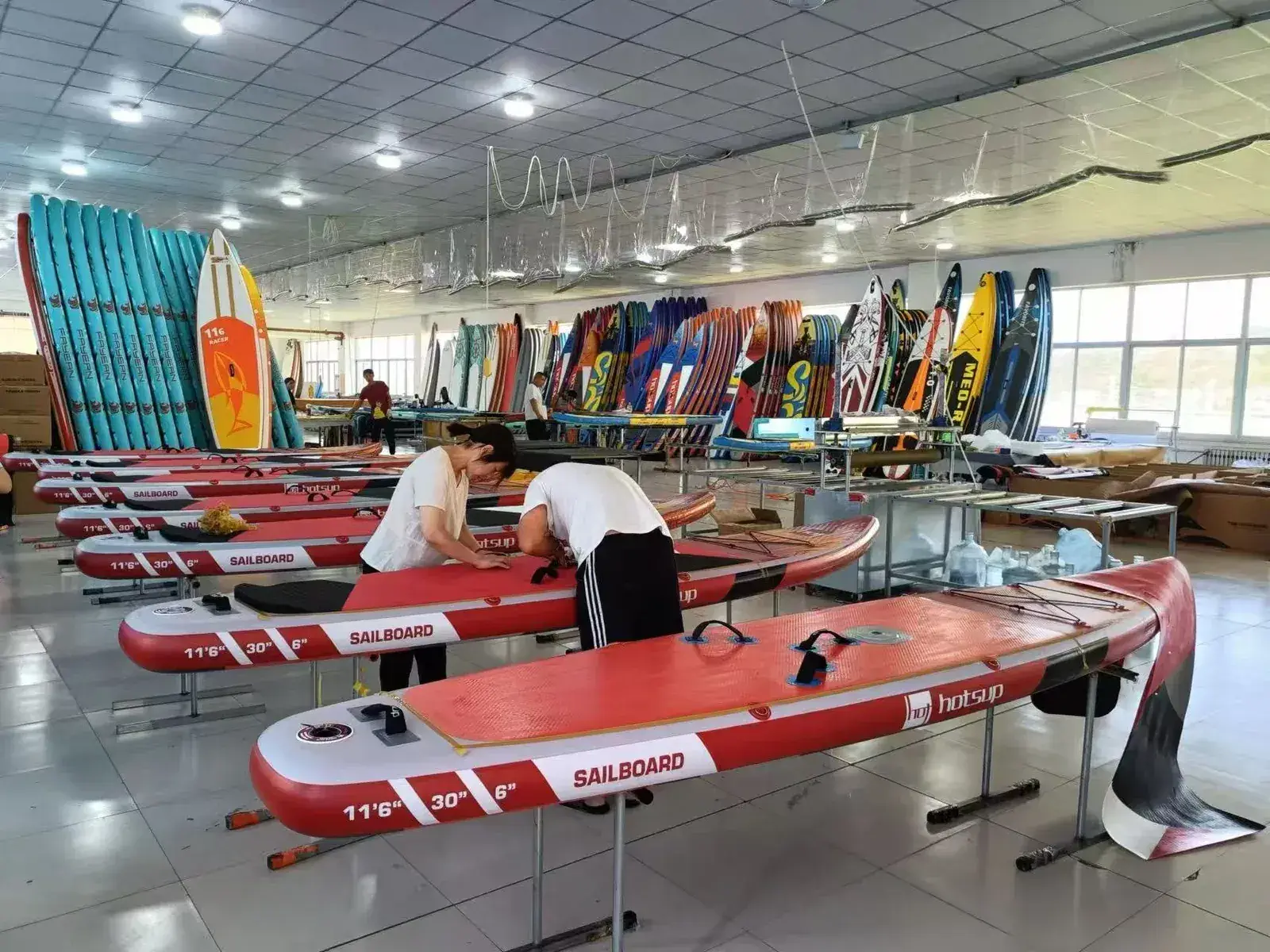
- Ask for photos of the production line and warehouse stock to verify capacity
- Start with a single-board sample to test under real rental conditions before bulk ordering
- Negotiate replacement valve and repair kit inclusion in the fleet order
- Confirm FOB shipping terms and lead time before committing to fleet volume
A wholesale inflatable paddle board order for a rental fleet typically runs 20 to 50 boards for a single location. Starting with a low MOQ sample batch lets you validate quality before committing. For guidance on shipping and export documentation, see our Water Bike Export Guide 2026 — the logistics principles apply equally to SUP shipments.
When you are ready to discuss your rental fleet requirements, reach out through our contact page — we work with rental operators across Europe on custom specifications, volume pricing, and delivery timelines tailored to seasonal launch windows.
FAQ: Inflatable SUP Rental Business
How long do inflatable SUP boards last in a rental fleet?
A well-constructed rental-grade inflatable SUP with high-density drop-stitch and reinforced rails typically lasts three to five seasons under daily rental use. Boards that are properly deflated, cleaned, and stored between seasons last longer. The most common failure point is valve wear — replaceable with a small part if caught early during routine inspections.
What PSI should rental-grade inflatable SUPs hold?
Rental boards should hold 15 PSI minimum, ideally 18 PSI for heavier paddlers or tandem use. Boards that cannot maintain pressure overnight have low-density drop-stitch or faulty valves — both are red flags for rental fleets. Always test a sample board at full pressure for 24 hours before committing to a fleet order.
Can I brand inflatable SUP boards for my rental business?
Yes. Full-color custom printing on the deck, rails, and bottom is standard with most OEM/ODM SUP factory partners. Starting from a low MOQ of a single board, you can prototype your branded design and scale to a full fleet. See our Custom SUP Boards page for details on customization options and minimum order quantities.
Conclusion: Start Your Rental Fleet the Right Way
The inflatable SUP rental business model works because inflatable boards solve the specific problems that rental operators face — storage, transport, and durability — while remaining affordable to acquire and simple to maintain. By choosing the right board specifications, working with a capable manufacturing partner, and building a branded fleet that stands out on the water, you position your rental business for sustainable seasonal revenue.
Ready to source rental-grade boards or build a custom-branded fleet? Start with a custom SUP board inquiry or contact our team to discuss your rental fleet requirements.