
Drop-Stitch Material Guide 2026: How Inflatable SUPs Get Their Rigidity
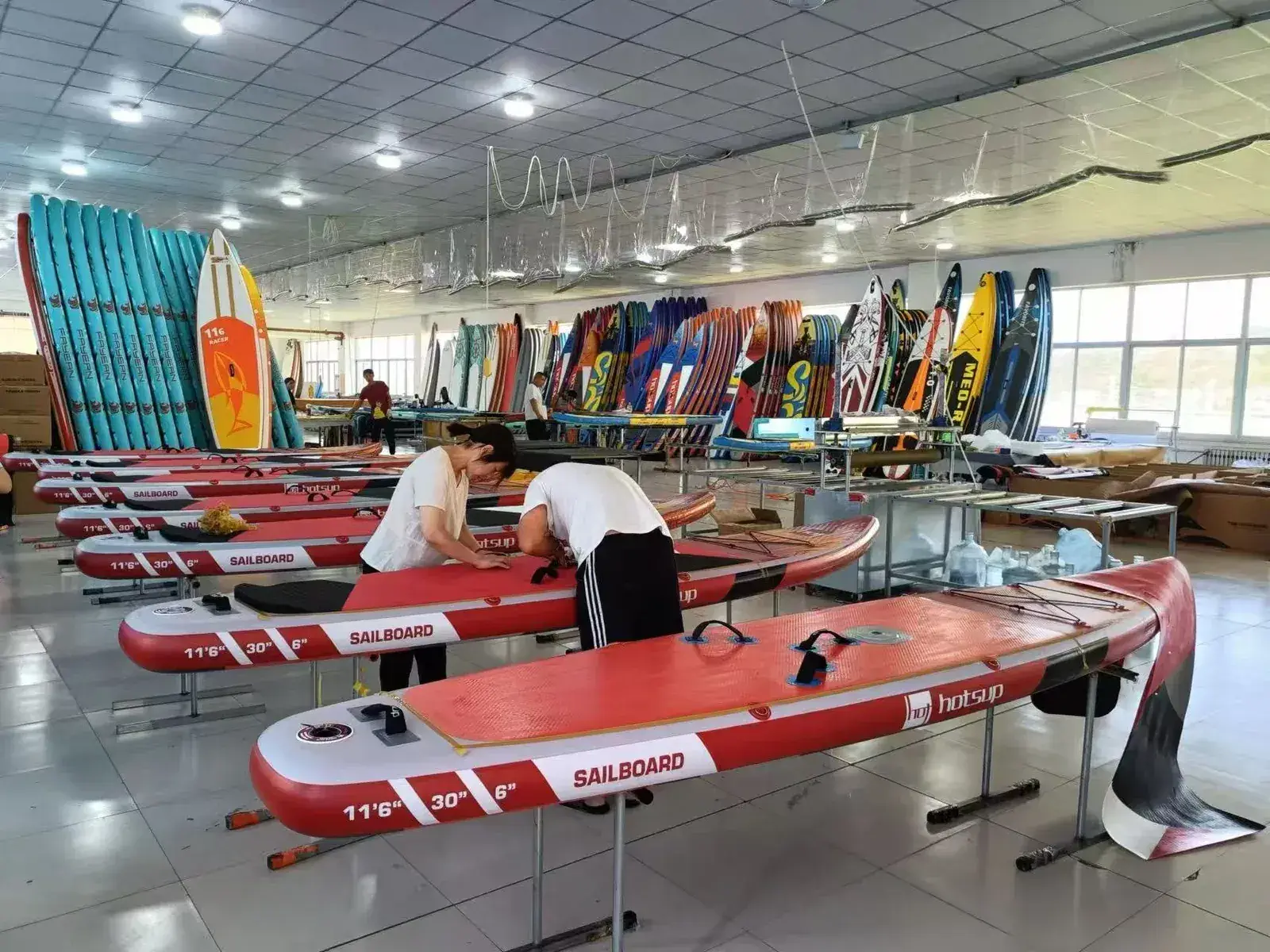
If you have ever wondered why a modern inflatable SUP feels almost as rigid as a hard board, the answer is two words: drop-stitch. It is the core technology behind every quality inflatable paddle board, kayak floor, and water-bike hull we build. Understanding it helps you choose the right product—and brief the right factory.
This guide covers what drop-stitch is, why it matters, the material choices that affect performance, and how to specify it for a private-label line.
What Is Drop-Stitch, Exactly?
A drop-stitch board is two layers of fabric (usually PVC-coated polyester) with thousands of fine threads connecting them, top to bottom, like a thousands of tiny vertical supports. When you inflate the board, those threads pull taut and hold the layers a fixed distance apart—typically 10–15 cm. The result: a structure that resists bending under foot pressure.
No drop-stitch, no rigidity. A board without it would just bulge into a sausage.
Why Rigidity Matters More Than Thickness
A rigid board tracks straight, edges into turns, and does not bounce under a paddler’s weight. That translates to:
- Faster paddling — less energy lost to flex.
- Better control — predictable in chop and current.
- Higher rider weight limit — the hull stays true under load.
This is why drop-stitch density, not raw thickness, is the spec that matters. Our V-shape SUP explainer shows how hull shape and rigidity work together for speed.
Density, Denier, and What the Numbers Mean
Three numbers tell you the build quality:
- Stitch count — threads per square inch. More threads = stiffer, pricier.
- Denier — thickness of the thread/fabric. Higher denier = more durable.
- PSI rating — how hard it can be inflated (typically 12–20 PSI for SUPs).
A touring or racing board wants higher density for stiffness; a yoga or all-around board can use a slightly lower density for a softer, more stable feel. A good OEM partner will recommend the right combo for your use case.
Single Wall vs Double Wall (Fusion)
Older boards used a single drop-stitch core with glued rails. Newer “fusion” or double-wall builds laminate the top and bottom directly to the core, dropping weight and glue lines. Benefits:
- Lighter board for the same stiffness.
- Fewer failure points at the seam.
- A cleaner, premium look for private label.
For a branded line in 2026, fusion construction is the baseline expectation in mid- and high-tier markets.
PVC vs TPU: The Outer Skin
The coated fabric around the core is usually PVC or TPU:
- PVC — cheapest, proven, easy to weld; fine for most brands.
- TPU — lighter, more abrasion-resistant, and more eco-friendly to produce; premium positioning.
TPU costs more but supports a “premium / sustainable” story if that is your market.
How to Choose for Your Brand
Brief your factory with the end use in mind:
- All-around / rental — mid density, PVC, fusion build, high PSI. Durable over light.
- Touring / racing — high density, possibly TPU, V-hull shape.
- Yoga / family — lower density for stability, wide outline.
Our water-sports product selection guide maps use cases to specs.
How Drop-stitch Ages
A quality drop-stitch core stays rigid for years, but it is not immortal. What wears out first is the PVC or TPU skin from UV and repeated high-pressure cycles—not the internal threads. Rotate your stock so the oldest boards sell or rent first, and keep demo units out of direct sun. A board that held 15 PSI on day one should still hold it in year three if the outer weld is intact; a soft board usually means a skin problem, not a core failure.
Repair and Field Care
Most punctures are in the outer skin, not the core, and a standard PVC patch kit fixes them in minutes. Equip every rental or retail unit with a repair kit, and train staff on the dry-patch method so a small nick never becomes a lost day. Cores that lose threads are rare and usually caused by hard impact; they are not field-repairable, which is exactly why commercial users should spec a higher denier build up front.
Drop-stitch vs a Solid Board
The fair question is whether you need drop-stitch at all. A foam or molded board is lighter and cheaper, but it cannot pack down, ships at three times the volume, and dents on impact. Drop-stitch trades a little weight for packability, repairability, and a rigid ride that survives rough handling—which is exactly why it dominates the inflatable category and why we build every SUP and kayak floor on it.
Bottom Line
Drop-stitch is the reason inflatable SUPs compete with hard boards. When you brief a factory, ask for the stitch density, denier, PSI, and whether the build is fusion (double-wall). Those four answers tell you more about real quality than any marketing photo. Talk to our manufacturing team and we will spec a drop-stitch build matched to your riders and your price point.