Building your own paddle board brand starts with finding the right private label paddle board manufacturer. Whether you are a distributor entering the European water sports market, a surf school launching a branded rental fleet, or an entrepreneur creating a niche SUP label, the manufacturer you choose determines everything from board quality to delivery timeline. This guide breaks down what to expect when working with an OEM/ODM SUP factory — from minimum order quantities and sample approval to full-container production and shipping.
What Does Private Label Mean in the Paddle Board Industry?
Private label manufacturing means you partner with an established OEM/ODM SUP factory that produces paddle boards to your specifications — your logo, your colors, your packaging — while the factory handles production, quality control, and export logistics. You get a finished product bearing your brand identity without investing in your own manufacturing facility.
In the inflatable SUP world, private label is the most common path for new brands. The factory already has the drop-stitch material supply chain, heat-welding equipment, printing capabilities, and quality protocols. Your job is to define the product specs and brand elements; the factory’s job is to deliver boards that meet those standards consistently.
This model differs from wholesale (buying pre-branded boards from a factory’s existing line) and from full custom development (designing a board shape from scratch). Private label sits in the middle: you choose from proven shapes and constructions, then customize the visual identity and accessory package. For most new brands entering the market, this is the sweet spot — enough differentiation to build a brand, without the cost and risk of ground-up R&D.
Minimum Order Quantity: What to Expect from a Private Label Paddle Board Manufacturer
MOQ is one of the first numbers buyers ask about, and it varies significantly between factories. Here is what you should know:
Sample MOQ vs. Production MOQ
Most reputable factories offer a sample order of MOQ 1 set — meaning you can get a single prototype made with your design before committing to a production run. This sample lets you evaluate board quality, print fidelity, accessory fit, and packaging in person. The sample typically takes 7–14 days depending on complexity and whether new artwork or tooling is required.
Production MOQs for private label paddle boards usually start at 20–30 pieces per model/size for a first order. Some factories require 50+ per size. The MOQ exists because each size and print design requires dedicated production setup — screen preparation, heat-welding parameters, quality inspection protocols. Below the MOQ, the per-unit cost rises sharply because setup costs are spread across fewer boards.
How MOQ Affects Pricing Tiers
Pricing typically breaks down into tiers: sample pricing (highest per unit), small-batch pricing (20–49 pieces), mid-volume pricing (50–199 pieces), and full-container pricing (200+ pieces). The price difference between a 20-piece order and a 200-piece order can be 30–50% per board. This is why experienced distributors start with a small batch to validate the market, then scale up to container orders once sell-through is proven.
If you want to explore small-batch options in detail, our custom SUP board manufacturer guide covers low-MOQ strategies for new brands.
The Private Label Production Timeline: Step by Step
Phase 1: Design and Spec Confirmation (3–7 days)
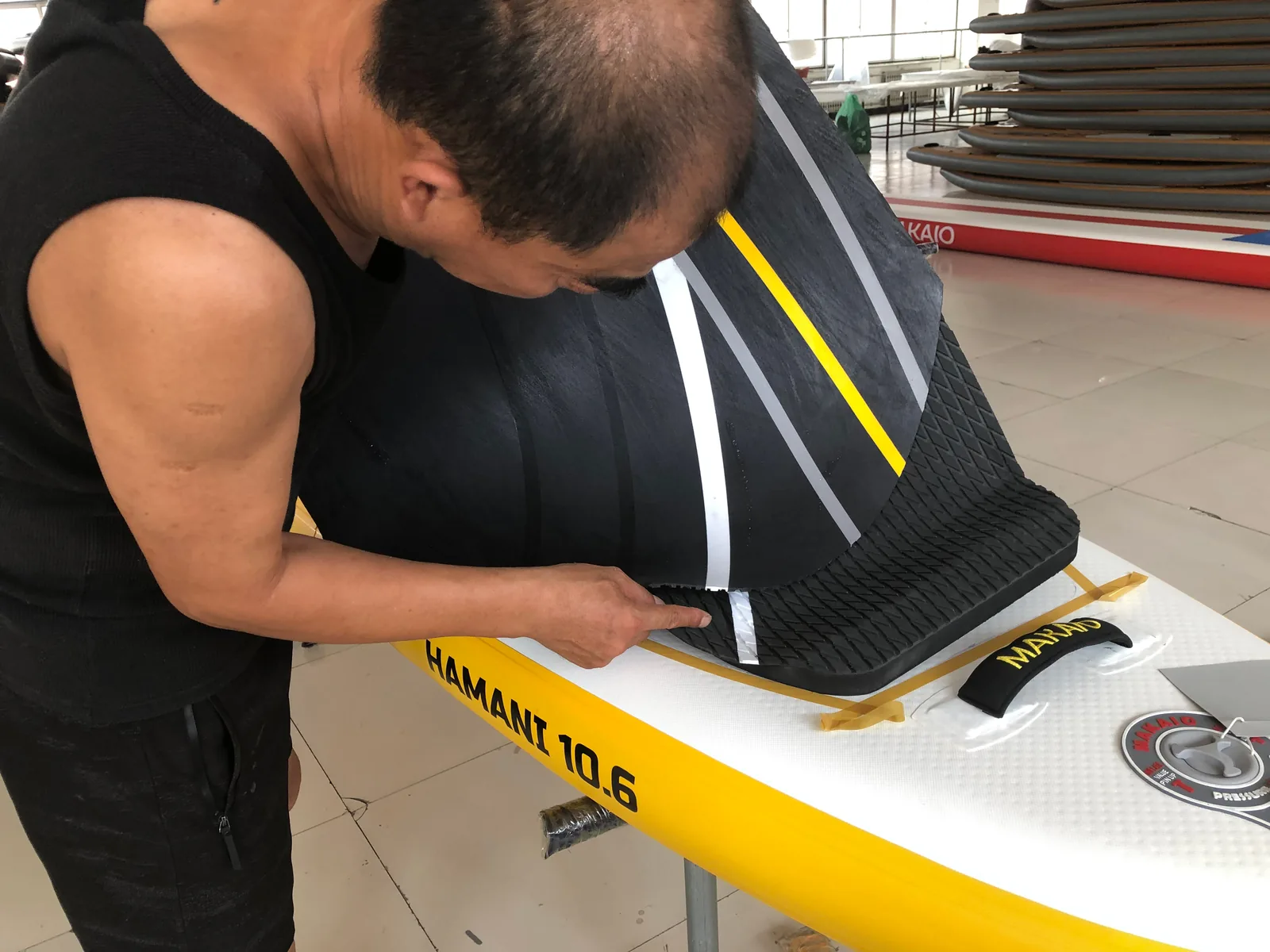
After you select a factory, the first step is finalizing your board specifications: model/shape, dimensions, drop-stitch density, PSI rating, rail construction (single-layer, double-layer, or reinforced), deck pad design, fin setup, and accessory package. You also provide your brand artwork — logo files, color codes, deck pad pattern, and packaging design.
The factory’s design team creates a production mockup for your approval. This is where you catch errors before they become expensive. Review the mockup on a real-size screen, check color accuracy against your brand guidelines, and confirm text placement. Once approved, this mockup becomes the production reference.
Phase 2: Sample Production (7–14 days)
With the mockup approved, the factory produces a physical sample. This is your golden ticket — do not skip this step. When the sample arrives, inspect it thoroughly: inflate to the rated PSI and hold for 24 hours to check for pressure loss, examine weld seams for consistency, verify print color and placement, test the fin box and accessory fittings, and review the packaging.
If revisions are needed, the factory produces a second sample. Most projects close within 1–2 sample rounds. For a detailed timeline from sample to container, see our OEM SUP lead time guide.
Phase 3: Bulk Production (15–30 days)
Once you approve the sample, bulk production begins. The factory orders drop-stitch material in your specified density and color, cuts and welds the board bodies, applies your print design, installs deck pads and fin boxes, and performs quality inspections at each stage. For a 100-piece order, expect 15–20 days; for a full 40HQ container (typically 200–250 boards depending on size and packaging), plan for 25–30 days.
Phase 4: Quality Control and Packaging (3–5 days)
Before packing, every board goes through final QC: inflation test, seam inspection, print quality check, and accessory verification. Boards that fail are reworked or replaced. Approved boards are rolled, inserted into your branded backpack, and packed with accessories (paddle, pump, leash, fin). Cartons are sealed with your custom shipping marks for export.
Phase 5: Container Loading and Export (2–5 days)
Finished cartons are loaded into a shipping container at the factory warehouse. The factory handles export documentation, customs declaration, and coordinates with the freight forwarder you designate. From container seal to port departure is typically 2–5 days.
Total timeline from first contact to container departure: 30–55 days for a straightforward private label project. Complex custom designs or peak-season production can extend this to 60+ days.
Choosing the Right Private Label Paddle Board Manufacturer
Not all factories are equal. When evaluating a paddle board supplier in China, look for these critical indicators:
1. In-House Production Capability
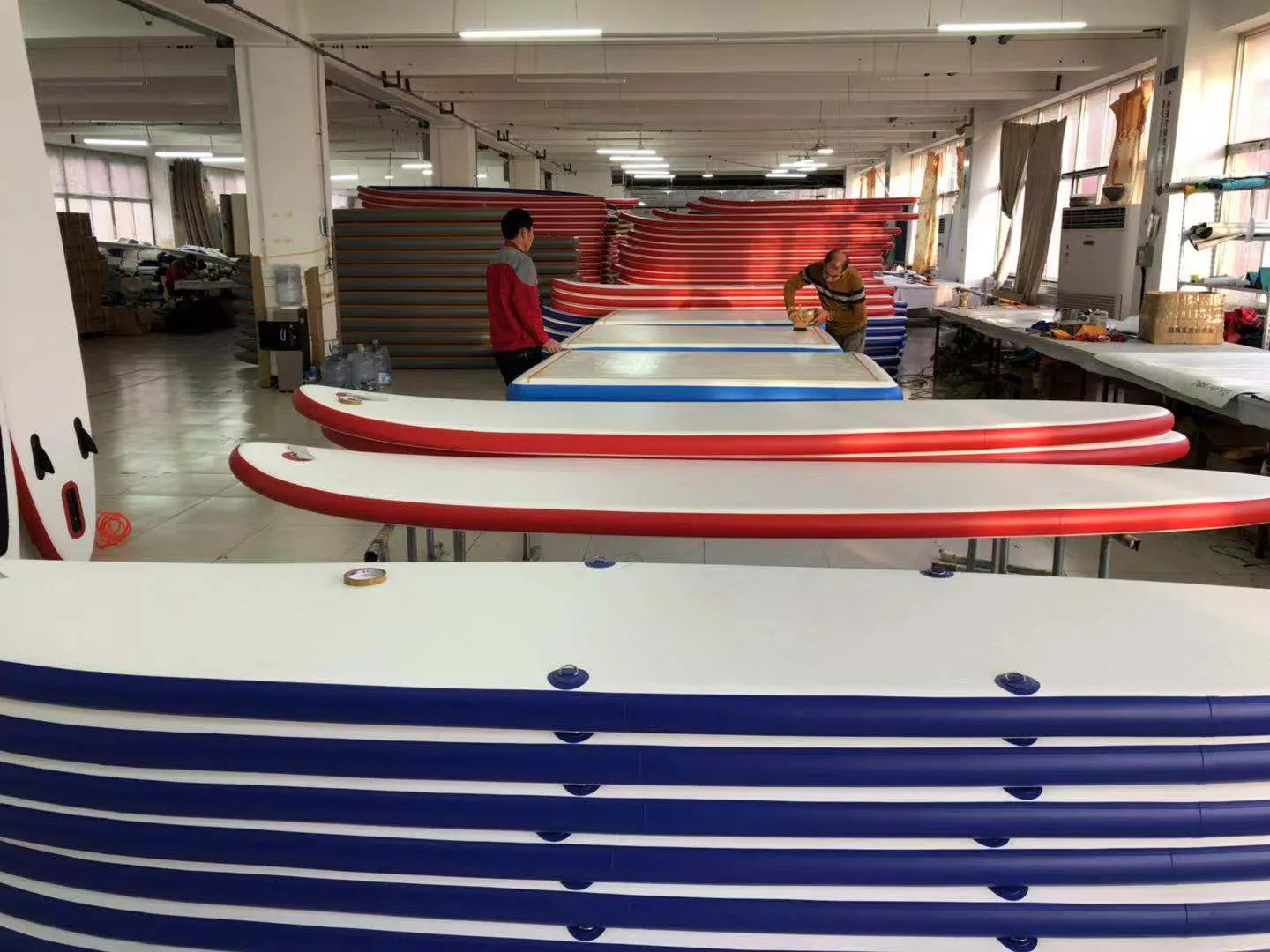
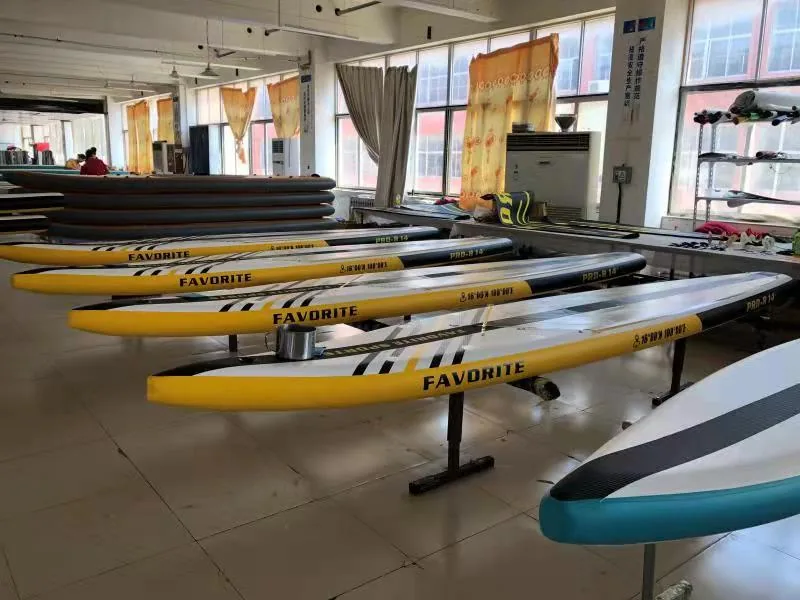
A genuine manufacturer owns its production equipment — heat-welding machines, printing facilities, and assembly lines — rather than outsourcing to third parties. In-house production means tighter quality control, faster turnaround, and accountability. Ask for factory photos, video tours, or schedule a virtual factory visit. A factory that cannot show you its production floor is likely a trading company.
2. Drop-Stitch Material Quality
The drop-stitch core is the single most important component of an inflatable SUP. Ask about the stitch density (measured in stitches per inch), yarn weight, and PVC grade. Premium boards use 4-inch or 6-inch drop-stitch with 18+ stitches per inch and double-layer rail construction. Budget boards use lower density, which means more flex, less rigidity, and shorter lifespan. Our drop-stitch material guide explains the specs in detail.
3. Customization Depth
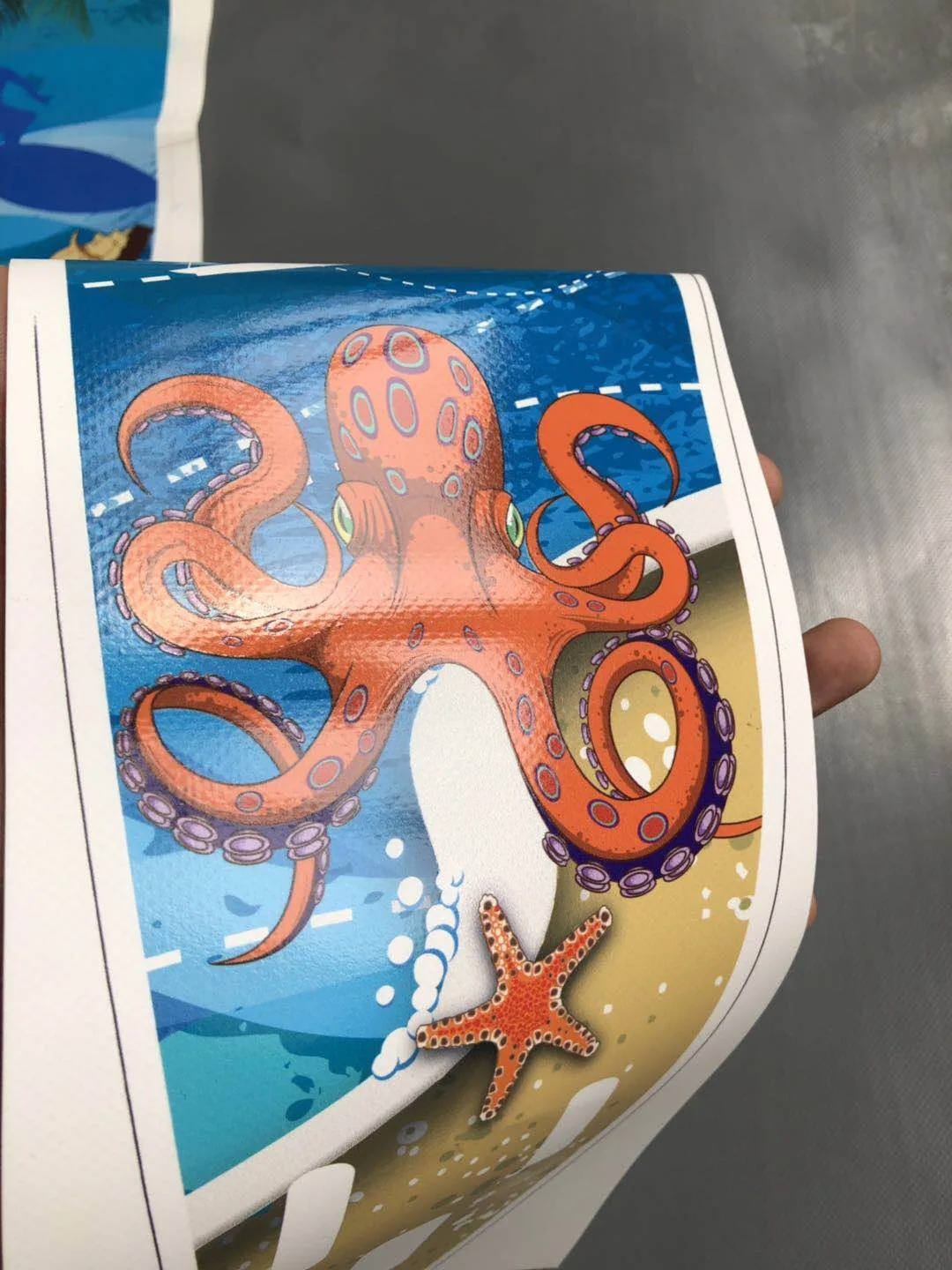
A capable private label manufacturer should offer full-print customization (not just logo stickers), multiple sizes per model, deck pad color and pattern options, fin box types (US fin box, slide-in fin, or click fin), and custom accessory bundles. If the factory only offers fixed templates with a logo stamp, you are looking at a limited OEM program, not true private label.
4. Export Experience
Shipping paddle boards internationally requires proper packing, carton specifications, and documentation. A factory with export experience knows how to pack for container shipping, handle customs paperwork, and work with freight forwarders efficiently. Ask which markets they currently export to and request references from buyers in your region.
Private Label vs. White Label vs. Full OEM: Which Is Right for You?
These terms are often used interchangeably, but they represent distinct manufacturing arrangements:
White label means the factory produces a standard board design and applies your logo. Minimal customization, fastest turnaround, lowest MOQ. Good for testing a market quickly.
Private label (also called OEM) means you select from proven board shapes and customize the full visual identity — full-print deck, rail color, deck pad, packaging. Moderate MOQ, moderate timeline. The sweet spot for most new brands.
Full ODM/custom means you collaborate on a new board shape or construction method. Highest MOQ, longest timeline, highest development cost. Reserved for established brands with specific performance requirements.
For a deeper comparison, our small-batch OEM customization guide breaks down the trade-offs for each model.
Common Pitfalls When Working with a Private Label Paddle Board Manufacturer
Skip the Sample to Save Time
The sample step costs a few hundred dollars and adds 1–2 weeks. Skipping it risks a full production run of boards with a print error, wrong deck pad color, or a fin box that does not fit your accessories. Always get a physical sample and approve it before production.
Under-Specifying Quality Requirements
If you simply say “I want a 10’6″ paddle board,” the factory will produce one at whatever quality level the price suggests. Instead, specify: drop-stitch density, PSI rating, rail construction type, deck pad material (EVA density and texture), and fin system. The more specific you are, the closer the result matches your expectations.
Ignoring Packaging and Shipping Specifications
Carton quality, board rolling method, and accessory packing affect whether your boards arrive in showroom condition or with creased deck pads and scratched rails. Specify double-wall cartons, individual board bags, and accessory placement. Our paddle board manufacturer selection guide includes a packaging checklist.
What Does a Private Label Paddle Board Cost?
We do not publish prices publicly because board costs depend on construction type, order volume, customization depth, and accessory package. However, here is what drives pricing:
- Construction: Single-layer woven drop-stitch is the most affordable; double-layer reinforced or fusion construction commands a premium for durability and stiffness.
- Customization: Full-print deck artwork adds cost compared to solid color rails; custom deck pad patterns cost more than standard EVA.
- Order volume: Per-unit cost drops significantly at 50+, 100+, and 200+ piece tiers.
- Accessories: Carbon paddle vs. aluminum paddle, double-action vs. triple-action pump, premium leash vs. standard — each choice affects the total package cost.
The best approach is to request a quote with your specifications, target volume, and desired accessories. You will receive a detailed pricing breakdown tailored to your project.
How to Start Your Private Label Paddle Board Brand
- Define your market: Research your target customers — rental businesses, retail shops, or direct-to-consumer. Each segment demands different board specs, sizes, and price points.
- Choose your board models: Select 2–3 proven shapes that cover your market needs. A popular starter range includes an all-around 10’6″ (32″ wide), a touring 11’6″, and possibly a kids’ or yoga board depending on your niche.
- Develop your brand identity: Finalize your logo, brand colors, deck pad design, and packaging. The factory’s design team can help translate your concept into production-ready artwork.
- Request samples: Get a physical sample of each model with your branding. Test them on the water — paddle, inflate, deflate, check durability.
- Approve and order: Once samples pass your review, place the production order with confirmed specs and packaging requirements.
- Plan your shipping: Coordinate with a freight forwarder or let the factory handle FOB terms. Know your landed cost including duties, VAT, and inland transport.
Ready to start? Visit our OEM page to learn about our private label capabilities, or contact us directly to discuss your project specifications.
FAQ: Private Label Paddle Board Manufacturing
What is the minimum order quantity for private label paddle boards?
Most factories accept a sample order of MOQ 1 set for prototype approval. Production MOQ typically starts at 20–30 pieces per model/size. Some factories offer flexible low-MOQ programs for new brands testing the market.
How long does it take to produce a private label paddle board order?
From design confirmation to container loading, expect 30–55 days for a standard private label project. Sample production takes 7–14 days, bulk production takes 15–30 days, and quality control plus packaging takes 3–5 days. Complex custom designs may extend the timeline to 60+ days.
Can I customize the deck pad, fin system, and accessories?
Yes. A capable private label manufacturer offers full customization including deck pad color and pattern, fin box type (US box, slide-in, click), rail color, full-print deck artwork, and accessory bundles. Specify your requirements during the design confirmation phase.
Do I need to provide my own artwork, or can the factory help with design?
Both. You can provide production-ready artwork (vector files, Pantone colors), or the factory’s design team can help translate your concept into print-ready files. Most factories include basic design assistance in the private label package.
Start Building Your Paddle Board Brand Today
Launching a private label paddle board brand is a strategic investment — the right wholesale inflatable paddle board partner makes the difference between a brand that thrives and one that stalls. With a clear understanding of MOQ, timeline, quality specs, and customization options, you are equipped to have productive conversations with manufacturers and make informed decisions.
At ForwardSUP, we operate our own production facility in Weihai, China — the heart of inflatable water sports manufacturing. We offer private label manufacturing with low MOQ, full-print customization, proven board shapes, and complete export logistics support. Whether you need 20 boards for a rental fleet or a full container for retail distribution, request a quote on our custom SUP boards page or reach out through our contact page. Our team will respond with a detailed proposal including board specs, timeline, and pricing tailored to your project.
For more insights on choosing the right manufacturing partner, read our complete manufacturer selection guide and our OEM lead time breakdown.